


20. Februar 2026
Modular instead of monolithic: How modern flexibility management works
In today's energy world, complexity is constantly increasing: decentralized energy generation, volatile feed-in, growing demands on grid stability and, at the same time, rising expectations for efficiency and cost-effectiveness. This also increases the demands on flexibility management. Flexibility management refers to the targeted control of energy generation, consumption, and storage in order to balance fluctuations in the grid, optimize costs, and enable new business models. At its core, decentralized systems such as photovoltaics, storage, heat pumps, and e-charging stations are intelligently networked and controlled. But what is the best way to achieve this?
The limits of traditional isolated solutions
Many solutions available on the market are so-called isolated solutions. They were mostly developed to solve a very specific problem, such as controlling a single type of system, optimizing a specific process, or connecting to a specific energy market. What initially sounds like a quick fix, however, has significant disadvantages in everyday use:
- Lack of compatibility: Standalone solutions often only speak their “own language.” They are rarely compatible with other systems, which makes it difficult or even impossible to integrate different systems, manufacturers, or interfaces.
- Difficult data transfer: Exchanging information between different systems is complicated, error-prone, and costs time and money. This makes it difficult to optimally exploit flexibility potential across system boundaries.
- Limited scalability: If the system needs to grow, e.g., through the integration of new systems or markets, an isolated solution quickly reaches its limits. Expansions are usually only possible with considerable technical and financial effort.
The advantages of a modular approach
To overcome these challenges, a modular and open approach to flexibility management is becoming increasingly important. Individual building blocks are flexibly combined to create a customized solution that adapts to individual requirements. The advantages are obvious:
- Interoperability: Systems and plants from different manufacturers can communicate with each other without any problems and be controlled jointly.
- Flexibility: New components, market products, or technologies can be easily integrated without having to set up the entire system from scratch.
- Real-time data processing: By networking all relevant data points, energy flows can be monitored and optimized in real time.
- Economical use of data: Every single data point can be used as a valuable building block for business models, whether for billing, optimization, or market participation.
- Transparency and controllability: Clear visualization of all energy flows creates trust and enables informed decisions.
The toolbox for modern flexibility management
Modern energy infrastructures require flexible, scalable solutions rather than rigid systems. That is why VGT deliberately does not rely on a monolithic overall system, but on a modular platform that can be adapted precisely to individual requirements. Users select the functions and modules they need and can expand them at any time. Without technological dependencies or integration hurdles.
Manufacturer-independent control via the device manager
At the heart of the VGT platform is the device manager, the technological interface to the real energy world. It enables the uniform connection of a wide variety of energy systems, from photovoltaics and heat pumps to battery storage and industrial consumption units. It does not matter which manufacturer the systems come from or which communication protocol they use. Integration is standardized and does not require individual programming.
Once connected, all systems can be monitored and controlled in real time, either individually or as a combined unit. The platform visualizes relevant operating data and energy flows, processes them for forecasts, and enables precise control depending on the objective: optimizing self-consumption, relieving the grid, or actively participating in the energy market.
Flexibly combinable products in the Flex module
In addition to technical integration, the economic use of flexibility is also key. The VGT Flex module offers a powerful solution here: our customers can choose from various preconfigured flexibility products and combine them to create their own Flex product tailored to their situation.
Direct access to energy markets via the platform means that these flexibilities can not only be used to benefit the grid, but also monetized in a targeted manner. This turns every connected device into a potential economic lever.
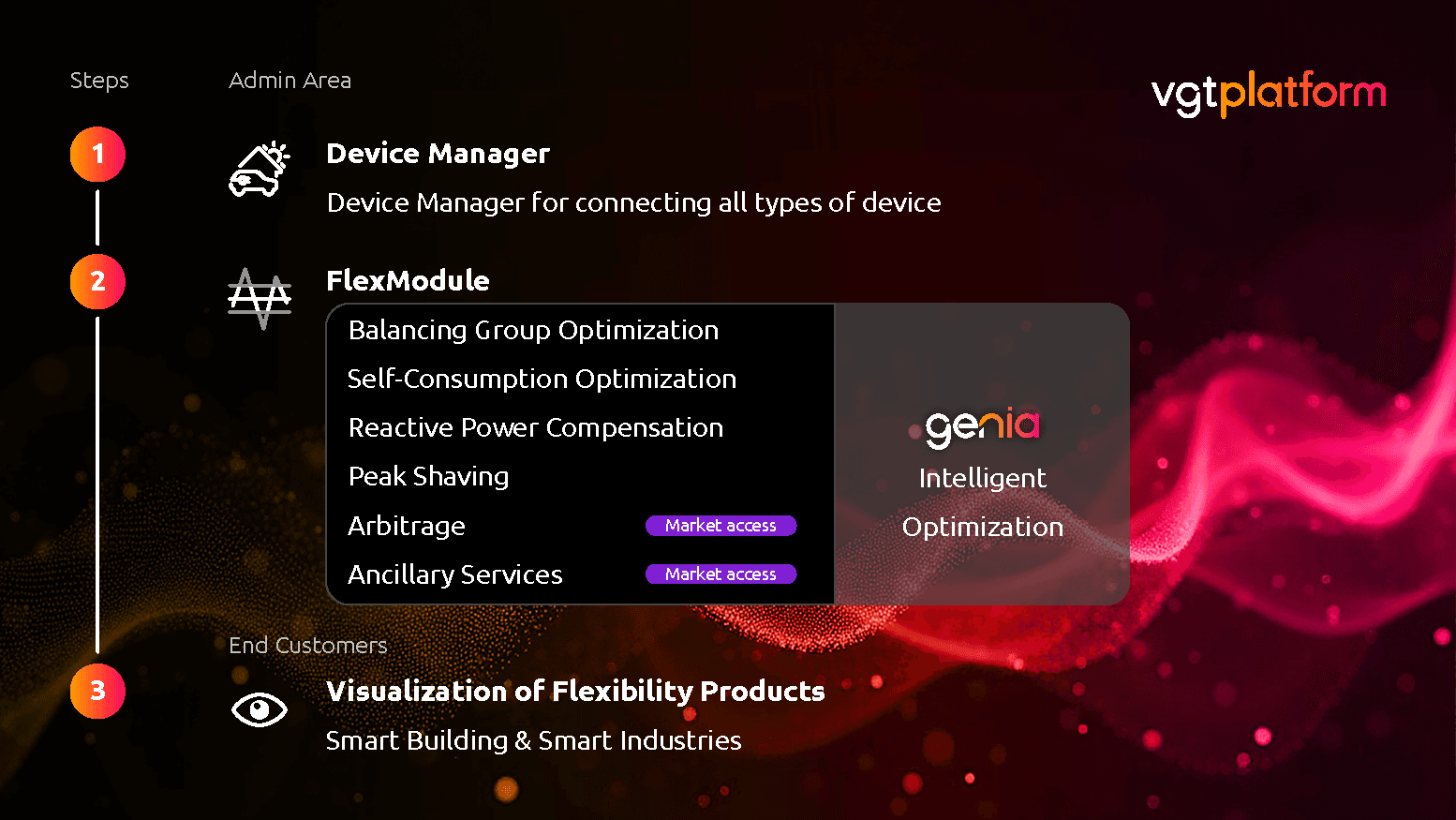
Flexibility management is a key component of the successful energy transition and the efficient use of decentralized energy systems. Modern platforms such as VGT enable a wide variety of systems to be integrated regardless of manufacturer, controlled flexibly, and used economically. The combination of real-time data, modular flex modules, and direct market access creates new opportunities for grid optimization and business models. Development remains dynamic, and the ability to operate flexibly and interoperably will become increasingly important in the future.
Would you like to experience our platform live?
Then arrange an exchange with us. We will show you how modern flexibility management works in practice.